WHAT’S GOING ON

Behind-The-Scenes

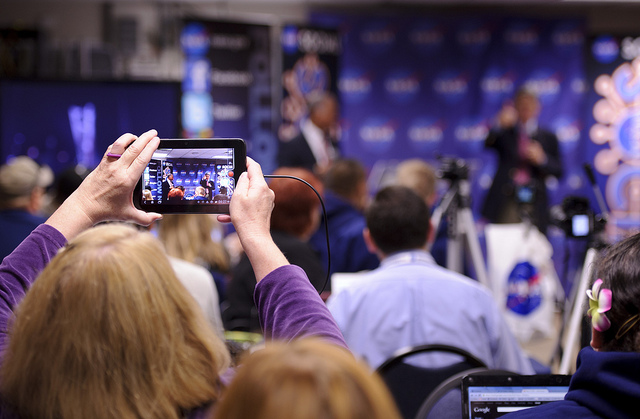
In the e3 Webcasting Studio

medium_5085445156.jpg

October 2, 2012 Tim Arthur0

[custom_frame_left]
Toddler Using iPhone photo credit: http://www.flickr.com/photos/clarkmaxwell/5085445156/ via http://photopin.com/ under a Creative Commons Lic. http://creativecommons.org/licenses/by-nc-nd/2.0/[/custom_frame_left][clear]

In a current survey by the research firm NPD Group, [ V64BG8CWNPSD ] it was identified that 37% of 4- and 5-year-old Americans were working with such mobile devices as a smartphone, tablet or iPod Touch, compared with less than a quarter of youngsters that age who utilized a laptop computer.
WSJ.com | 17 September 2012

photo credit: clarkmaxwell via photopin cc


clickmeeting_infographic_feature_sm.jpg

August 10, 2012 Isaac Arthur0

[custom_frame_left]
Top 7 Webinar Statistics You Should Know Infographic[/custom_frame_left][clear]

The world is waking up to the exciting and valuable potential that webcasting can bring. Earlier in July, we looked at an Infographic created by AD:60 on the benefits of mobile sites, and particularly why this is relevant in light of webstreaming. They were not alone in their recognition of this technology. ClickMeeting, a company that provides online meeting services, recently released an Infographic of their own showing the advantages of “World Wide Webinars.” The observations made there are more feathers in the cap for webcasting, and add further credence to it’s necessity, as well as showing how empowering it can be to any company and/or event.

[custom_frame_left]
Top 7 Webinar Statistics You Should Know Infographic[/custom_frame_left]
Top 7 Webinar Statistics You Should Know Infographic by ClickMeeting

ClickMeeting looked at 8,197 online meetings in a 6-month period. (That means they examined 205 meetings a week and 872 per month. They clearly had access to a lot of material.) Their findings tell us:

    • 1. Most companies run more than 1 webinar a month

      According to the graphic, currently only 32% of companies are not running any webinars, while in contrast, 18% of companies run 1 to 3, 17% run 4 to 6 a month, 16% are running 7 to 12 webinars, 8% of companies rack up 13 to 26, and an even larger 9% of companies will run 27 or more in a given month!

      Those numbers show that ground is ripe for webcasting/webinar providers. With a 68% majority of businesses running webinars each month, and 50% running somewhere between 4 and 27 (or more) webinars a month, why not? e3 livestream services can help you get started today. This shows that the services of webstreaming are in high demand in the corporate world.

    • 2. People join webinars from all over the world

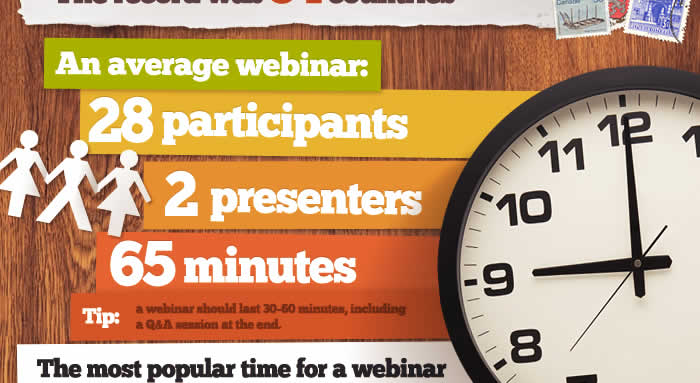
      The demand for webcasting is not restricted by geographic borders, but rather it is a global phenomenon. As this graphic shows, people from the U.S.A., Canada, Brazil, Norway, the UK, France, Egypt, Iran, Russia, Japan, Australia and more joined the webinars that ClickMeeting studied. These webinar statistics show the average webinar had 28 participants, 2 presenters, and ran for 65 minutes. (A good webinar should last 30-60 minutes the Infographic tells us.) There were people from at least 2 countries in an average webinar, while the record number has been 54 countries represented in the attendance of a single webinar!

      By incorporating webcasting into your company or event, you have the opportunity to reach an international audience!

    • 3. The most popular time for a webinar

      It’s also important to note what times are most expedient for webinars and webstreaming. Of those webinars researched on this Infographic, only 9% of them were held on Monday, then came Thursday with 16.7%, Friday with 17.9%, then Wednesday with 25.6%, and the most popular being Tuesday with 30.8% of the webinars being held on that day. As to time of day, the majority of the webinars were between 11am and 3pm. This shows that most webinars are on workdays during work hours, meaning that the market for webcasting/webinars is largely within corporations and businesses, though certainly not limited to that field.

    • 4. Why do people organize webinars?

      There are many reasons why one would organize a webinar and require webcasting services. Those give by the Infographic are: educating existing and potential customers (85%), lead generation (77%), building a strong position on the market (60%), converting new contacts (54%), making new contacts (31%), and making a webinar recording (30%). Whatever your reason may be, webcasting is an efficient and effective tool for businesses and events.

      Next, ClickMeeting goes on to explain How to organize a webinar:

    • 5. Traditional presentation: (1) About the company, (2) Our offer, (3) Our offer for you [or] Webinar presentation: (1) The main benefit, (2) Q&A, (3) Additional information, (4) Q&A, (5) Our offer, about the company, and (6) Q&A

      In the traditional presentation approach you spend the majority of your time giving background on the company, what you offer in general and then only a small portion of the presentation is directed at the specific needs of the customer/audience (“Our offer for you”).

      However, with a webinar, the structure is much more dynamic, allowing you to cut straight to the chase. You are freed to highlight the main benefits that your company/event is offering, and then give any additional information required as revealed by the interaction of the Q&A sessions. This means spending less time in exposition about the company, or general offers that are irrelevant to your particular audience. Thus, you get much greater effectiveness when you take advantage of webinars and webcasting for your presentation.

      Lastly, the Infographic gives the modus operandi for Inviting participants and promoting the webinar:

    • 6. When/Where?

      Getting the word out beforehand is crucial. The Infographic gives a basic outline of what people do to invite and promote their webinar/event. At 7 days before you should have a sign up form on your website. By 2 days before you have been promoting it and discussing it on your blog. Then, by the time it’s 2 hours before you start cranking it out in newsletter[s], on social media, on LinkedIn, through professional websites and forums and event websites. These are some simple steps ways to get let people know about your event ahead of time.

    • 7. Tools to use during webinar:

      Because you’ll want to go back and see how it went, archive it, and more, you’ll definitely want to record your webinar/event. Then, your presentation begins. It may include audio + video elements; you may want to use a whiteboard during the event; and you will definitely want to utilize the chat feature of hosting meetings/events/webinars online.

Through this Infographic, we’ve been introduced to some of the many reasons why webcasting is so valuable, and we’ve been given tips and facts to keep in mind so that we can make the best use of the technology. Webcasting is a prime option for any business, conference or any other organization or event to consider. The wide world is using webcasting technology through webinars; the only question now is: why aren’t you?


Mobile-Map.jpg

July 10, 2012 Isaac Arthur0

[custom_frame_left]
10 Reasons Why Your Event Webcast Needs a Mobile Friendly Site[/custom_frame_left][clear]

Thank you AD:60. The team at AD:60 recently released an infographic depicting “10 Reasons Why You Need a Mobile Site.” Because this is something of utmost importance to the process of webcasting an event, it would be profitable to reiterate the points made by AD:60. After seeing these reasons you’ll see why a mobile site is an increasingly indispensable aspect of webcasting.

[custom_frame_left]
10 Reasons Why You Need a Mobile Site Infographic[/custom_frame_left]
10 Reasons Why You Need a Mobile Site Infographic by AD:60

Following are some e3 Webcasting observations on the above infographic:

  • 1. 8% of all digital traffic comes from smartphones and tablets.

    8% may not seem that significant, until one puts it into the context of the following reasons.

  • 2. Most mobile phones in America will be smartphones by the end of 2012.

    This point is accompanied by a graph that shows how, in 2010, according to the graphic, Nielsen Mobile Insights 70% of mobile phones were feature phones and only 30% were smartphones, which have steadily climbed over the past two years to where they are nearly 50-50 at this point. Based on that, it is expected that smartphone usage will soon surpass feature phones, which probably will in turn affect the percentage given in Reason 1.

  • 3. More and more users are making purchases on their phones.

    As smartphones multiply, more and more people are using their phones to make purchases. As this graph shows, in 2010 purchases made on phones was only at 23%. By 2012 that number has grown to 35% and it is predicted to be as high as 43% by the year 2015.

  • 4. The proportion of mobile-only users is even higher in developing countries.

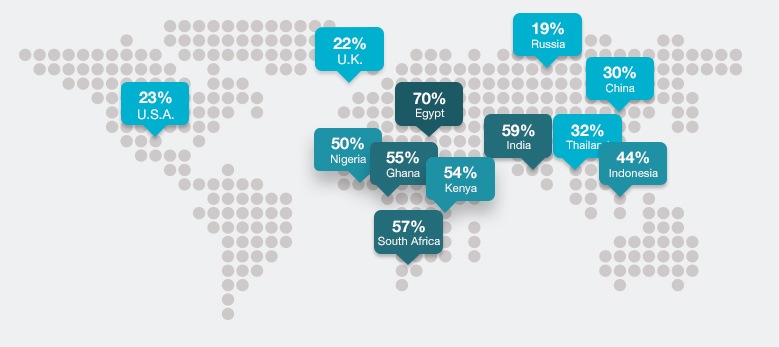
    A map on this graphic depicts the fact that while nations more developed have a relatively low percentage of mobile-only users (23% for the U.S.A., 22% in the U.K. and only 19% in Russia), nations such as Egypt (70%), India (59%), South Africa (57%), Nigeria (50%) and Indonesia (44%) have notably higher numbers. A good mobile site is necessary, but even more so if your market/audience is global. There is no excuse for a worldwide event or corporation to not have a good mobile site.

  • 5. Mobile commerce is growing fast.

    Forrester Research Mobile Commerce Forecast reported that while mobile commerce was only $3 billion in 2010, it has reached $10 billion now, in 2012, and is forecasted to increase to more than ten times where it was in 2010 by 2016, at $31 billion!

  • 6. Smartphone users cover a wide demographic.

    The infographic tells us that smartphones are used by 67% of those between the ages of 18 and 24. Going on, 71% of those 25-34 years, 54% of 35-44 year-olds, 44% between 45 and 54 years, 31% of people 55-84 years and 13% of those 65 years and up use smartphones. This is a large and wide demographic. Of those, 14% of men and 9% of women have made purchases on their phones. You cannot afford to ignore this demographic.

  • 7. Couch commerce is rising.

    59% of customers are using their mobile devices to shop from their homes. Just as online stores became necessary with the coming of the Internet, so too as mobile use picks up it becomes more and more essential to businesses/corporations/events to have mobile friendly sites.

  • 8. Smartphone users have higher than average income.

    The median U.S. household income is roughly $50,000 – while 60% of smartphone users earn more than $100,000. With more than double the average U.S. income, reaching these potential customers with a mobile friendly site becomes an indispensable must.

  • 9. Mobile sites are important for both physical and digital stores.

    This is so, says AD:60, because 46% of customers will use their phone to research products before making an in-store purchase. 41% will research and then buy on a computer, and 37% will make their purchase via phone after researching on a mobile device. This information lets us infer that having a good mobile site is vital for physical stores, even more than for online ones.

  • 10. Your normal site is NOT thumb-friendly.

    With the majority of smartphones being touch-screen, not having a mobile site is very damaging for digital traffic. The regular site is created for a computer screen, thus requiring a lot of thumbing, pinching, zooming – unwanted hassle – for mobile users to navigate a site; this weakens their response to what your site has to offer. Who wants to exert that much energy? Getting a sharp mobile-friendly site will help you to better receive the benefits cited in Reasons 1-9.

  • That wraps-up the “Ten Reasons” on the infographic, and already there are copious reasons to get a mobile-friendly site. I would add just one more reason, in relation to our purposes:

  • 11. Mobile sites are important for webcasting.

    Without a mobile-friendly site your webcasting venture (be it a conference, event, or whatever), will exclude a large percentage of your audience. Viewing a live-streamed video on a mobile device when the site was created for the desktop PC is difficult and frustrating; but with a mobile-friendly site ready for subscribers who are viewing on their smartphones, you provide a much more professional and appealing presentation for the event’s audience. A mobile site, as AD:60 has illustrated so masterfully, is indispensable for websites in general, but with a live streamed event, where you have no idea if your potential audience will be on a computer or a device, than their importance must be stressed even more emphatically.

We’ve now seen the ten (or eleven) reasons why your webcast needs a mobile-friendly site. There is no reason to hesitate in taking advantage of the benefits that they bring. As time goes on, it appears that this will become even more needed. So why not? Mobile users the world over are waiting.


5_Ways_to_Use_Webcasting_for_Events_and_Conferences.jpg

June 29, 2012 Isaac Arthur0

[custom_frame_left]
[/custom_frame_left][clear]

If you want to maximize the capabilities of webcasting and live streaming then you’ve got to know the different ways that it can be used. There are countless ways that webcasting can be beneficially implemented by businesses and/or events, including: keynote speaker addresses, conference presentations, breakout sessions/conference tracks, trade show announcements, and even post conference follow-ups. After reading this article, you should be better informed on the ways that you could utilize webcasting to your advantage.

  • Keynote Speaker Address

    Keynote addresses are huge, meant to communicate core ideas and values to the audience and produce enthusiasm for the company or organization’s message, the overall tone of an event, or exciting announcements (think of Apple’s highly-anticipated addresses.) Webcasting can help you achieve that goal with greater effectiveness and scope. Because webcasting is via the Internet, this opens up a worldwide audience to your address, who will be eagerly listening in and participating through the online community. Not only does this open up doors for potential audience members, but it also provides greater flexibility for the speakers, as they could deliver an address from virtually anywhere and be seen and heard by the event attendees (both physical and virtual), thus maximizing keynote success and diminishing schedule problems. Webcasting could revolutionize a keynote address for your organization’s event, and on throughout the entire event.

  • Conference Presentation

    Once a keynote address is given, your audience is jazzed about your company and/or event, but usually there’s still more to come. Webcasting will play a huge role in any conference presentation. Not only will online audiences be able to watch the unfolding event, but they will also be able to participate through online chatting, Q-and-A, audience polling, and more. This will make conferences more accessible and less expensive for attendees by cutting back on travel costs and allowing people to attend from wherever they can get an Internet connection. While there are still huge perks to being at an event live and in person, this will increase your event’s coverage and extend the amount of people you are able to reach. Conference presentations are just one way that webcasting is able to help you make the most of your event.

  • Breakout Sessions/Conference Tracks

    You might think that an event’s online audience would be excluded from joining in on breakout sessions, or different conference tracks, but this too is within the range of possibilities that are presented through webcasting. All it takes is camera nearby in order to provide the web-stream crowd with access to any breakout session or extra feature at the conference/event.

  • Trade Show Announcements

    Normally, tradeshows are limited in who they can reach to those who can be physically in attendance. This means that many who are unsure whether they are interested in your products or services, do not attend. Travel costs and other factors keep them away. By providing webcasting you have an invaluable opportunity to demonstrate your trade wares to the world, and then direct them to where they can purchase what you have to offer, all with the click of a mouse.

  • Post Conference Follow-ups

    Even after a conference is over webcasting equips you with a way to follow-up with attendees, provide them with supplemental resources, as well as direct them to new info, coming events, and related products. This means that you are able to continue the event or conference long after the scheduled date is over, and those who attended in person have gone home. You can post pictures, videos, articles and requested material onto the event’s site – even host a second online event if you needed to. The sky is the limit.

Webcasting has the power to expand the horizons of any event. We’ve looked at the incredible opportunities that this technology opens up. Whether you are thinking about streaming a keynote address, a conference presentation, breakout session or conference track, or trade show, and how webcasting even creates an opportunity to expand your options beyond the actual event through post conference follow-ups. And this is merely the tip of the iceberg! Even utilizing just one of these ways to use webcasting would transform your event or conference, and heighten its success beyond your imagination!

e3 Webcasting, LLC., will manage all aspects of production for your live event webcast so that you can focus on what’s important, “your event’s message”. Our professional webcasting crew will provide you with a single point of contact for live webcasting and streaming production. We will work with you, as well as for you, to execute an effectively successful live webcast event.

For more information regarding the streaming services provided by e3 Webcasting or to speak with a representative, please contact us or give us a call at 888-695-2396.


e3_streaming_video.jpg

June 15, 2012 Isaac Arthur0

[custom_frame_left]
[/custom_frame_left][clear]

New technology always leads to expansion. It could be a physical expansion such as national borders or agrarian production and industry, it could be intellectual: an expansion of culture, literacy and ideas. The roads built by the Roman Empire made possible the swift movement legions of soldiers, to their political and military advantage, but it also led to the proliferation of the Christian gospel, which proved to be their ideological undoing. A brief look at the history of invention and innovation, from the printing press to the internet, from the telegraph to the smart phone, from the cotton gin to modern farming machinery, the roads of Rome to the automobiles of Henry Ford, Galileo’s telescope to landing a man on the moon, and so on, technological advancement has led to possibilities that previous generations did not have. We now live in a world where technology surrounds us, and the tools we need to advance in business, communication, or any other pursuit, are literally at our fingertips. Here are e3 Webcasting, one such portal into new and exciting possibilities is live video streaming, we like to call it e3 streaming video.

For instance: my family is involved in a speech and debate league for homeschoolers. Recently, when my brothers competed in an out-of-state tournament, those of us still at home crowded around my mother’s iPhone as we listened to the award ceremony by means of the speakerphone. Distant, garbled words and distracting noises made hearing the tournament results nearly impossible. Because of this difficultly, we normally just wait for a text message or phone call after the ceremony. No image, no interaction, just anticipating the news report when it’s all over. Wouldn’t it be neat if there were a way to somehow be there (without actually being there); to be able to watch the event live, maybe even interact digitally as it happens? There is a way to do just that: It’s called live streaming.

Live streaming video enables video, whether of an event, lecture, conference, (etc.) to be broadcasted (that is, webcasted) to anywhere on the planet (provided there’s a computer and internet) instantaneously. People “tuning-in” to the webcast can even interact via chat boxes and social media. The potentialities and possibilities of this technological tool-set are numerous and vast. Just as previous inventions have revolutionized the world, so too video streaming will, and is today. Filmmakers, web developers, and anyone who works in the media business have a vested interest in this. Streaming is transforming the way that films and television are distributed to audiences, as witness the rise of services like Netflix, Amazon Instant Video and Apple TV. But this is not a service that is limited to those corporations or Hollywood honchos. This is something that can – and should – be used by as many individuals, groups, companies, and organizations as need it (see: “Benefits of Streaming and Webcasting Events”).

Just as the printing press allowed for written material to be dispersed to larger audiences, giving writers the influence to change the world, video streaming – the Gutenberg of our times – gives one the ability to reach people, to work with greater flexibility, liberty and ease, and in the long run, to affect change through streamed media content. That’s why at e3 Webcasting we are dedicated to “changing the world one webcast at a time.”


e3 Webcasting
Privacy Overview

This website uses cookies so that we can provide you with the best user experience possible. Cookie information is stored in your browser and performs functions such as recognising you when you return to our website and helping our team to understand which sections of the website you find most interesting and useful.