
WHAT’S GOING ON

Behind-The-Scenes

In the e3 Webcasting Studio

GMO-FREE-Jeffrey-Smith.jpg

November 9, 2012 Isaac Arthur0

Arnout Kazemier from Nodejitsu, @3rdEden, presenting at RealtimeConf

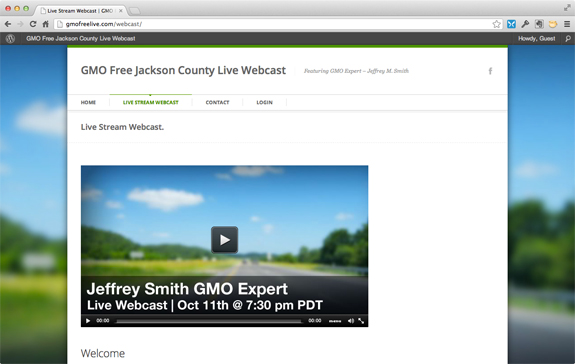
What if you could have accessed vital information about a biotech industry hijacking of American foods and agriculture – information that could change the way you think, eat, shop, and vote – all from the comfort of your home? Well, for one night in the middle of last month, you could have. That is, e3 Webcasting live streamed a talk given by author, activist, and filmmaker Jeffrey M. Smith put on by GMO-Free Jackson County and sponsored by the Ashland Food Co-op and Project Rogue Valley via the GMO-Free Live website.

Smith’s talk dealt with the terribly adverse effects of genetically modified organisms (GMO’s) on the health of human beings, the soil of our farms, and the threat to the very freedoms of our nation posed by monopolistic GMO-promoting companies like Monsanto and Syngenta. His books and recent film, titled “Genetic Roulette: The Gamble of our Lives,” join a long line of films and books, such as the Academy Award Nominated documentary “Food, Inc.” and agricultural reformer Joel Salatin’s book “Folks, This Ain’t Normal” in sounding a warning against GMOs.

This issue is one that involves a wide range of people from various age groups, walks of life, and political persuasions. From concerned conservatives to the liberal “foodies” of the organic movement, from farmers to scientists to health fanatics, GMOs have become a hot-button topic of discussion and debate. Jeffrey Smith spoke to an auditorium full of Southern Oregon residents, some of them die-hard supporters of Project Rogue Valley already, and others, perhaps, merely curious about the controversy surrounding GMOs, and which has been raging since their introduction. That night represented the efforts of a grassroots movement from the local area, and Smith was practically a celebrity there. He was able to bring his knowledge of the issue to bear; knowledge gained from extensive research, writing, and leadership around to the world. He has worked hard to educate citizens, empower activists, and influence legislators. He spent the night citing facts and data, exposing the destructive track record of GMO’s in our nation and globally. He made a strong case for attaining the status of “GMO-free” for Jackson County, as well as for other initiatives such as California’s Prop 37, a bill requiring GMO products to be labeled, which is currently being battled out in the Golden State. His talk was persuasive, despite the marketing and the political spin created by the GMO manufacturers. As second U.S. President John Adams once said, “Facts are stubborn things; and whatever may be our wishes, our inclinations, or the dictates of our passions, they cannot alter the state of the facts and evidence.”

Wherever you come down on this particular issue, webcasting events such as these can help spread awareness, and bring in a wider audience then those already committed or curious enough to attend in person. There are many causes like GMO-Free Jackson County that need to broadcast their message to American citizens, or even to worldwide audiences. Live streaming could be the key to disseminating critical information and starting a movement. That’s what e3 is all about: changing the world, one webcast at a time…


clickmeeting_infographic_feature_sm.jpg

August 10, 2012 Isaac Arthur0

[custom_frame_left]
Top 7 Webinar Statistics You Should Know Infographic[/custom_frame_left][clear]

The world is waking up to the exciting and valuable potential that webcasting can bring. Earlier in July, we looked at an Infographic created by AD:60 on the benefits of mobile sites, and particularly why this is relevant in light of webstreaming. They were not alone in their recognition of this technology. ClickMeeting, a company that provides online meeting services, recently released an Infographic of their own showing the advantages of “World Wide Webinars.” The observations made there are more feathers in the cap for webcasting, and add further credence to it’s necessity, as well as showing how empowering it can be to any company and/or event.

[custom_frame_left]
Top 7 Webinar Statistics You Should Know Infographic[/custom_frame_left]
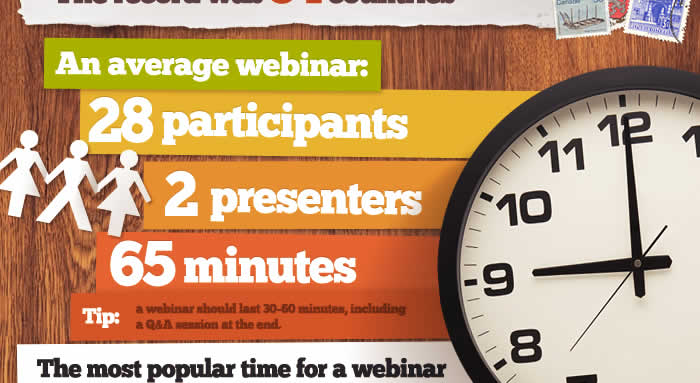
Top 7 Webinar Statistics You Should Know Infographic by ClickMeeting

ClickMeeting looked at 8,197 online meetings in a 6-month period. (That means they examined 205 meetings a week and 872 per month. They clearly had access to a lot of material.) Their findings tell us:

    • 1. Most companies run more than 1 webinar a month

      According to the graphic, currently only 32% of companies are not running any webinars, while in contrast, 18% of companies run 1 to 3, 17% run 4 to 6 a month, 16% are running 7 to 12 webinars, 8% of companies rack up 13 to 26, and an even larger 9% of companies will run 27 or more in a given month!

      Those numbers show that ground is ripe for webcasting/webinar providers. With a 68% majority of businesses running webinars each month, and 50% running somewhere between 4 and 27 (or more) webinars a month, why not? e3 livestream services can help you get started today. This shows that the services of webstreaming are in high demand in the corporate world.

    • 2. People join webinars from all over the world

      The demand for webcasting is not restricted by geographic borders, but rather it is a global phenomenon. As this graphic shows, people from the U.S.A., Canada, Brazil, Norway, the UK, France, Egypt, Iran, Russia, Japan, Australia and more joined the webinars that ClickMeeting studied. These webinar statistics show the average webinar had 28 participants, 2 presenters, and ran for 65 minutes. (A good webinar should last 30-60 minutes the Infographic tells us.) There were people from at least 2 countries in an average webinar, while the record number has been 54 countries represented in the attendance of a single webinar!

      By incorporating webcasting into your company or event, you have the opportunity to reach an international audience!

    • 3. The most popular time for a webinar

      It’s also important to note what times are most expedient for webinars and webstreaming. Of those webinars researched on this Infographic, only 9% of them were held on Monday, then came Thursday with 16.7%, Friday with 17.9%, then Wednesday with 25.6%, and the most popular being Tuesday with 30.8% of the webinars being held on that day. As to time of day, the majority of the webinars were between 11am and 3pm. This shows that most webinars are on workdays during work hours, meaning that the market for webcasting/webinars is largely within corporations and businesses, though certainly not limited to that field.

    • 4. Why do people organize webinars?

      There are many reasons why one would organize a webinar and require webcasting services. Those give by the Infographic are: educating existing and potential customers (85%), lead generation (77%), building a strong position on the market (60%), converting new contacts (54%), making new contacts (31%), and making a webinar recording (30%). Whatever your reason may be, webcasting is an efficient and effective tool for businesses and events.

      Next, ClickMeeting goes on to explain How to organize a webinar:

    • 5. Traditional presentation: (1) About the company, (2) Our offer, (3) Our offer for you [or] Webinar presentation: (1) The main benefit, (2) Q&A, (3) Additional information, (4) Q&A, (5) Our offer, about the company, and (6) Q&A

      In the traditional presentation approach you spend the majority of your time giving background on the company, what you offer in general and then only a small portion of the presentation is directed at the specific needs of the customer/audience (“Our offer for you”).

      However, with a webinar, the structure is much more dynamic, allowing you to cut straight to the chase. You are freed to highlight the main benefits that your company/event is offering, and then give any additional information required as revealed by the interaction of the Q&A sessions. This means spending less time in exposition about the company, or general offers that are irrelevant to your particular audience. Thus, you get much greater effectiveness when you take advantage of webinars and webcasting for your presentation.

      Lastly, the Infographic gives the modus operandi for Inviting participants and promoting the webinar:

    • 6. When/Where?

      Getting the word out beforehand is crucial. The Infographic gives a basic outline of what people do to invite and promote their webinar/event. At 7 days before you should have a sign up form on your website. By 2 days before you have been promoting it and discussing it on your blog. Then, by the time it’s 2 hours before you start cranking it out in newsletter[s], on social media, on LinkedIn, through professional websites and forums and event websites. These are some simple steps ways to get let people know about your event ahead of time.

    • 7. Tools to use during webinar:

      Because you’ll want to go back and see how it went, archive it, and more, you’ll definitely want to record your webinar/event. Then, your presentation begins. It may include audio + video elements; you may want to use a whiteboard during the event; and you will definitely want to utilize the chat feature of hosting meetings/events/webinars online.

Through this Infographic, we’ve been introduced to some of the many reasons why webcasting is so valuable, and we’ve been given tips and facts to keep in mind so that we can make the best use of the technology. Webcasting is a prime option for any business, conference or any other organization or event to consider. The wide world is using webcasting technology through webinars; the only question now is: why aren’t you?


e3_streaming_video.jpg

June 15, 2012 Isaac Arthur0

[custom_frame_left]
[/custom_frame_left][clear]

New technology always leads to expansion. It could be a physical expansion such as national borders or agrarian production and industry, it could be intellectual: an expansion of culture, literacy and ideas. The roads built by the Roman Empire made possible the swift movement legions of soldiers, to their political and military advantage, but it also led to the proliferation of the Christian gospel, which proved to be their ideological undoing. A brief look at the history of invention and innovation, from the printing press to the internet, from the telegraph to the smart phone, from the cotton gin to modern farming machinery, the roads of Rome to the automobiles of Henry Ford, Galileo’s telescope to landing a man on the moon, and so on, technological advancement has led to possibilities that previous generations did not have. We now live in a world where technology surrounds us, and the tools we need to advance in business, communication, or any other pursuit, are literally at our fingertips. Here are e3 Webcasting, one such portal into new and exciting possibilities is live video streaming, we like to call it e3 streaming video.

For instance: my family is involved in a speech and debate league for homeschoolers. Recently, when my brothers competed in an out-of-state tournament, those of us still at home crowded around my mother’s iPhone as we listened to the award ceremony by means of the speakerphone. Distant, garbled words and distracting noises made hearing the tournament results nearly impossible. Because of this difficultly, we normally just wait for a text message or phone call after the ceremony. No image, no interaction, just anticipating the news report when it’s all over. Wouldn’t it be neat if there were a way to somehow be there (without actually being there); to be able to watch the event live, maybe even interact digitally as it happens? There is a way to do just that: It’s called live streaming.

Live streaming video enables video, whether of an event, lecture, conference, (etc.) to be broadcasted (that is, webcasted) to anywhere on the planet (provided there’s a computer and internet) instantaneously. People “tuning-in” to the webcast can even interact via chat boxes and social media. The potentialities and possibilities of this technological tool-set are numerous and vast. Just as previous inventions have revolutionized the world, so too video streaming will, and is today. Filmmakers, web developers, and anyone who works in the media business have a vested interest in this. Streaming is transforming the way that films and television are distributed to audiences, as witness the rise of services like Netflix, Amazon Instant Video and Apple TV. But this is not a service that is limited to those corporations or Hollywood honchos. This is something that can – and should – be used by as many individuals, groups, companies, and organizations as need it (see: “Benefits of Streaming and Webcasting Events”).

Just as the printing press allowed for written material to be dispersed to larger audiences, giving writers the influence to change the world, video streaming – the Gutenberg of our times – gives one the ability to reach people, to work with greater flexibility, liberty and ease, and in the long run, to affect change through streamed media content. That’s why at e3 Webcasting we are dedicated to “changing the world one webcast at a time.”


watching_streaming_video_on_smartphone.jpg

May 31, 2012 Tim Arthur0

[custom_frame_left]
[/custom_frame_left][clear]

Rapidly exceeding the popularity associated with traditional mobile phone models, smartphones will be the fastest growing cellular market sector in the western world. Growing out of PDA (personal digital assistant) technologies, smartphones combine personalized organizational capabilities along with full media capabilities and communications technologies. As cellular companies such as Verizon wireless, T-Mobile and AT&T / Cingular continually expand their particular network coverage and boost the speed of their data services, so too have developers leaped to produce useful apps for downloading to your smartphone devices.

Full HTML5 Web Browsing is Coming

Even though more advanced models of classic mobile phone models offered limited browsing on the World wide web, modern smartphones provide full rendering of HTML5 websites, enabling you to browse the internet as you would on your desktop computer. Browsing functions vary depending on your model of smartphone, however in most cases, scrolling can be accomplished by swiping your index finger across the screen and clicking links by tapping the touchscreen.

Online Video Streaming

Along with bigger displays and sharper resolutions, the latest smartphone designs are getting better at streaming online video footage and purchasing movies from web based vendors like Netflix. Due to faster cellular networks, touch screen phones are designed for streaming both HTML5 as well as Flash video, enabling you to view videos on sites such as YouTube.com, Facebook and Vimeo.com. Furthermore, mobile phones such as the iPhone as well as Android enable you to upload video from your smartphone utilizing USB, Bluetooth or Wi-Fi connectivity.

Along with many other features such as GPS Navigation, and third-party apps, smartphones are dominating the mobile phone industry.

With the proliferation of the smart phone, everyone now has a TV / video player in their pocket. Contact e3 Webcasting at (888) 695-2396 to make sure your next event streams effortlessly on all mobile devices.


e3 Webcasting
Privacy Overview

This website uses cookies so that we can provide you with the best user experience possible. Cookie information is stored in your browser and performs functions such as recognising you when you return to our website and helping our team to understand which sections of the website you find most interesting and useful.