
WHAT’S GOING ON

Behind-The-Scenes

In the e3 Webcasting Studio

TXJS_Stream.jpg

June 5, 2013 Isaac Arthur0

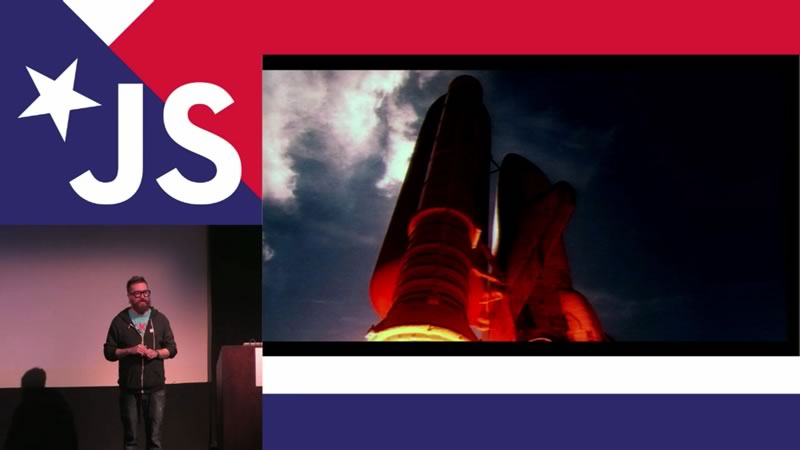
Webcasting from Austin, Texas, The e3 Webcasting crew powers up the live stream for TXJS.

As people across the nation tuned into the TXJS Live Stream Webcast to view the conference from the convenience of their office, iPad or smartphone the conference team was getting ready to open the doors. It was a hot Texas day, although still early in the morning, as men and women crowded into the historic Paramount Theatre in Austin. Laptops open, a cup of coffee and a taco in hand, the audience got ready to hear from co-laborers and experts in their particular line of work. What event was this? The Texas JavaScript Conference (TXJS) held on April 15, 2013.

Topics Covered at TXJS

JavaScript (JS) may be beyond the comprehension of most of us not in the programming world, but for those in that field this event proved to be quite an exciting and festive gathering. Speakers from around the United States and the United Kingdom spoke on a variety of subjects, from HTML, CSS, and Node.js to things like web applications, entrepreneurism, content management systems, the legal issues related to open source, and how the British government was able to revamp their “user experience.” Sound like a jam-packed day? That wasn’t even the half of it!


Conference organizer Alex Sexton brought together this diverse group of developers and designers to celebrate, learn, and anticipate the future of their craft. With the TXJS Conf. being only a one-day event, there was a lot to fit into the sessions, and a lot of catching-up and networking to do in between.

Live Video Webcast Expands the TXJS Conference Reach

But, with something as big and widely used as JavaScript, the estimated 325 people in attendance there at the Paramount in Austin were not the only interested parties; nor were they the only die-hard JS fans out there. This year e3 Webcasting was brought in to provide live streaming of all the sessions for TXJS. Once the stream went live and the talks began, 250 + online viewers tuned in to catch the event. These were not merely distant, mildly curious on-lookers who tuned in for five minutes and moving on – this was a steady audience-base that hung with us for the majority of the day. The numbers grew throughout the morning sessions, which began around 9 am, and only started decreasing toward the end of the day (which wrapped up at roughly 6:30 pm). The largest amount of online viewers exceeded 300. This means that nearly double the amount of people who actually came to Austin that day were able to be a part of the conference’s activities.

Frances Berriman | TXJS 2013 from SlexAxton on Vimeo.

Reaching the other 90% of Your Audience via Streaming

Clearly, whether we’re talking about a weeklong mega-event or a single-day, one-track conference, everyone has the ability to maximize the potential of webcasting technology to reach the other 90% of their audience that isn’t physically present. It was a pleasure to be a part of Texas JavaScript Conference and to bring the event to the more-than-300 people who were able to watch the stream that day. This was not only a success for this year’s TXJS, but could also have benefits in the future – anyone avid enough to watch a conference online for a whole day will definitely want to be there in person the following year! Like the final speakers who talked about the future of the industry and the exciting places it might go, we are thrilled to be involved in the business of webcasting, and are looking forward to what comes next.

TXJS 2013 Conference 411

If you’d like to learn more about the TXJS Conference or would like to attend a conference in the future, you can find out more by visiting the conference website or following them on Twitter:
Website: TXJS
Twitter: @TXJS
Conference Videos On Demand: TXJS Vimeo Channel

RealTimeConf_image.jpg

November 9, 2012 Isaac Arthur0

[custom_frame_left]
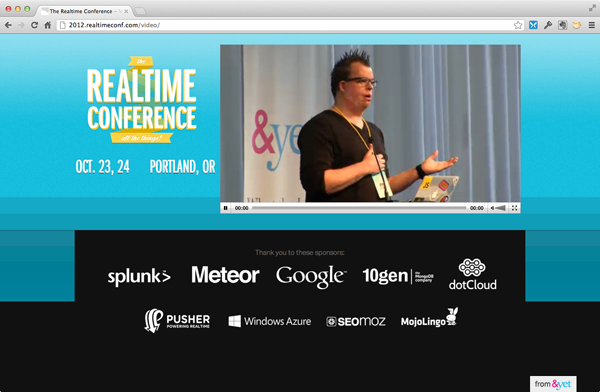
Arnout Kazemier from Nodejitsu, @3rdEden, presenting at RealtimeConf[/custom_frame_left][clear]

For just two days, programmers and developers from all over the world gathered under one roof in Portland, Oregon for the 2012 Realtime Conference organized by web application and design team &yet, and sponsored by such companies as Google, DotCloud, Windows Azure, SEOMOZ, MojoLingo, and more. This was the second year this kind of an event had happened. Last year in November the same group put on the “Keeping It Realtime” conference. However, this year would be different in one crucial way: this year &yet hired e3 Webcasting to live stream the conference and the more narrowly focused RedisConf the day before (see previous article for details).

[custom_frame_left]via the RealtimeConf live web stream[/custom_frame_left]The conference was held at PureSpace, a venue in Portland’s Pearl district. The people at &yet had a big vision for making this conference the highlight of the year for their attendees: they did things with style. On the first morning, the attendees were shuttled to the conference from the hotel, but were dropped off a few blocks away where a marching band awaited them to escort the crowd of developers into the building with fanfare! That night, the conference set them home with a surprise performance by a children’s choir. Delicious food, lots of coffee, and an impressive line-up of speakers kept the conference rolling; but behind all this, there was a team of busy workers making it all happen. As the providers of the live streaming, e3 Webcasting was part of that crew.

Flexibility and problem solving are required whenever you are dealing with live events (which is the definition of webcasting). For instance, the night before the conference, as we were setting up our gear, we discovered that the projector, which was supposed to have an HDMI connection, only had a VGA connection. Thankfully, we were able to track down a converter / scaler that allowed us to use the projector feed in the live streams (for the presenters’ slides). But, in spite of technical speed bumps, the conference’s webcast turned out excellently.

The final night of RealtimeConf, &yet founder Adam Brault gave an inspiring call-to-action to his family of techies. He boldly challenged them to pursue the betterment of their work, and in the process, the betterment of the world. “To whom much has been given, much is required.” He called on his audience to become leaders in their respective spheres of influence. This stirring address put all the information that had been covered over the last two days into perspective. Thankfully, those who were unable to physically travel to Oregon did not have to miss out on this motivating presentation, thanks to live-streamed video. From the very first session of the conference to Adam’s closing talk, remote viewers were able to participate in the annual event. Webcasting the conference made it possible to spread the excitement and the inspiration of Realtime to a wider audience; incentivizing people who will want to be a part of it next year, and who knows where it will go from there.

[message type=”custom”]If you’d like to learn more about the RealtimeConf or would like to attend next year’s conference you can find out more by visiting the conference website or following them on Twitter:
RealtimeConf
@RealtimeConf
#RealtimeConf
[/message]

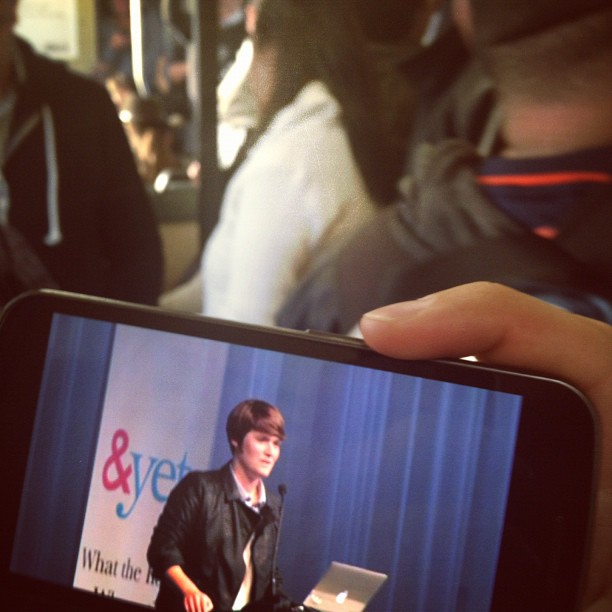
photo credit: Watching @caseorganic talk at #realtimeconf, in real time, on BART! Aaron Parecki via a cc


Redis-Conf-Grfx.jpg

October 27, 2012 Isaac Arthur0

Aren Sandersen from Pinterest, @P-arensand, presenting at RedisConf

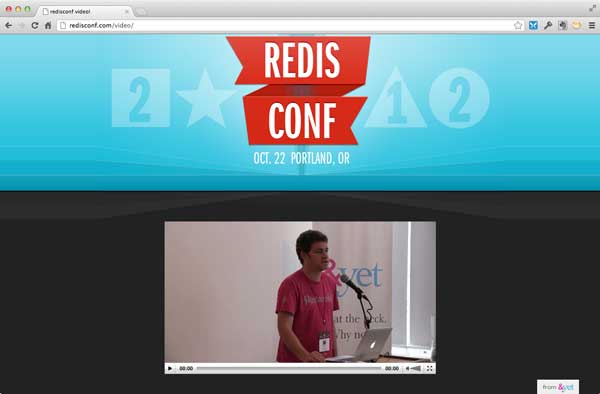
On October 22, e3 Webcasting live streamed the RedisConf in Portland, Oregon. It is a one day conference born out of the larger Realtime Conference put on by web application and design company &yet, focused specifically on the niche of programmers and developers who use the open-source database known as Redis, which is a development project sponsored by VMware.

The amazing team at &yet, led by Adam Brault, created a welcoming, unique, and creative environment for their diverse community to come together. Though a smaller-scale gathering, compared to it’s big brother the Realtime Conf, the RedisConf was well organized and stimulating. People from all over the United States, as well as internationally, came to this once-a-year event. It was a chance to network, discuss ideas, get updates on the progress made by other colleagues from around the world, and learn new techniques. Where the Realtime Conf would deal with the wider spectrum of topics related to realtime application development (for laymen, think Twitter instantly updating posts in “realtime”), the Redis Conference dug into the pros and cons related to using Redis as a multi-use tool on the Internet.

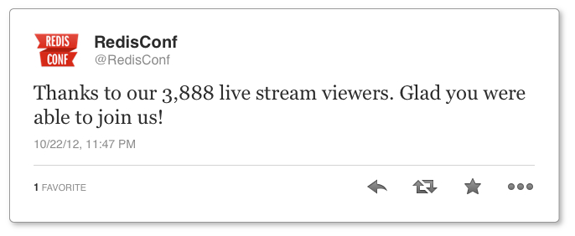
Tweet by @RedisConf

The &yet team kicked off the RedisConf with a performance of Bohemian Rhapsody rewritten from a RedisConf point of view. Streaming live from The Cleaners at the Ace Hotel, over the Internet connection &yet had installed by the pro’s at Stephouse Networks, the conference was off to a great start. Speaker after speaker got up and presented to the audience of about 150-200 men and women in the room; Pieter Noordhuis, @pnoordhuis was on hand to talk about the Redis Core, and Salvatore Sanfilippo, @antirez, even spoke from his home in Italy via several pre-recorded videos.

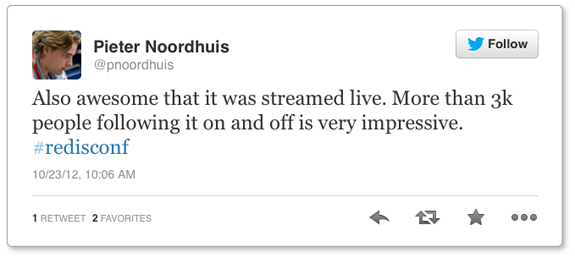
Tweet by Pieter Noordhuis @pnoordhuis

The conference attendees listened with laptops open, absorbing the info; while we were busy making sure that the people who were watching online had the best possible video experience. As the day went on, an Amazon AWS EC2 outage started unfolding. Which, as reported by Techcrunch, affected major services such as Foursquare, Reddit, Minecraft, GitHub, Heroku, imgur, Pocket, Coursera and HipChat. Providentially, we were unaffected and the video stream went off without a problem! Overall, though there are always things that could have been improved, the RedisConf stream was a huge success. Later, we were informed by Adam Baldwin of &yet that the live stream had been watched by as many as 3,000 online viewers!

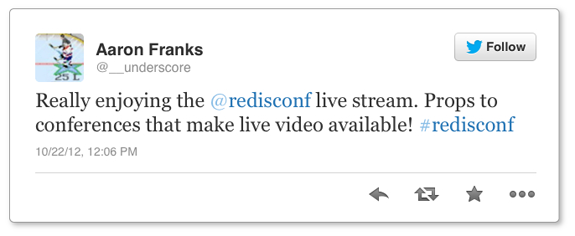
Tweet by @__underscore

People raved about the live stream on Twitter. They were impressed by the quality of the video, and they voiced their enthusiasm online. The RedisConf live web stream was a smash hit!

Many conferences think live-streaming is too expensive to be a viable option for smaller events, or have had negative experiences with poorly executed webcasts in the past. Many remote viewers were grateful for the chance to view the conference even though they were unable to attend in person. I suspect that there are many other conferences out there that could benefit from a well-done live stream webcast.

[message type=”custom”]

RedisConf 411

If you’d like to learn more about the RedisConf or would like to attend next year’s conference you can find out more by visiting the conference website or following them on Twitter:
Website: RedisConf
Twitter: @redisconf
Hashtag: #redisconf
[/message]


Mobile-Map.jpg

July 10, 2012 Isaac Arthur0

[custom_frame_left]
10 Reasons Why Your Event Webcast Needs a Mobile Friendly Site[/custom_frame_left][clear]

Thank you AD:60. The team at AD:60 recently released an infographic depicting “10 Reasons Why You Need a Mobile Site.” Because this is something of utmost importance to the process of webcasting an event, it would be profitable to reiterate the points made by AD:60. After seeing these reasons you’ll see why a mobile site is an increasingly indispensable aspect of webcasting.

[custom_frame_left]
10 Reasons Why You Need a Mobile Site Infographic[/custom_frame_left]
10 Reasons Why You Need a Mobile Site Infographic by AD:60

Following are some e3 Webcasting observations on the above infographic:

  • 1. 8% of all digital traffic comes from smartphones and tablets.

    8% may not seem that significant, until one puts it into the context of the following reasons.

  • 2. Most mobile phones in America will be smartphones by the end of 2012.

    This point is accompanied by a graph that shows how, in 2010, according to the graphic, Nielsen Mobile Insights 70% of mobile phones were feature phones and only 30% were smartphones, which have steadily climbed over the past two years to where they are nearly 50-50 at this point. Based on that, it is expected that smartphone usage will soon surpass feature phones, which probably will in turn affect the percentage given in Reason 1.

  • 3. More and more users are making purchases on their phones.

    As smartphones multiply, more and more people are using their phones to make purchases. As this graph shows, in 2010 purchases made on phones was only at 23%. By 2012 that number has grown to 35% and it is predicted to be as high as 43% by the year 2015.

  • 4. The proportion of mobile-only users is even higher in developing countries.

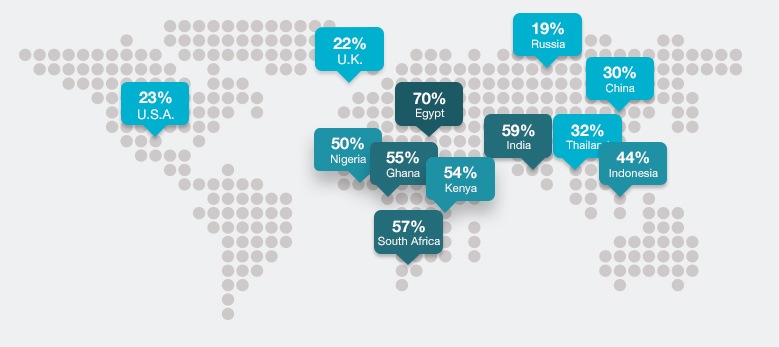
    A map on this graphic depicts the fact that while nations more developed have a relatively low percentage of mobile-only users (23% for the U.S.A., 22% in the U.K. and only 19% in Russia), nations such as Egypt (70%), India (59%), South Africa (57%), Nigeria (50%) and Indonesia (44%) have notably higher numbers. A good mobile site is necessary, but even more so if your market/audience is global. There is no excuse for a worldwide event or corporation to not have a good mobile site.

  • 5. Mobile commerce is growing fast.

    Forrester Research Mobile Commerce Forecast reported that while mobile commerce was only $3 billion in 2010, it has reached $10 billion now, in 2012, and is forecasted to increase to more than ten times where it was in 2010 by 2016, at $31 billion!

  • 6. Smartphone users cover a wide demographic.

    The infographic tells us that smartphones are used by 67% of those between the ages of 18 and 24. Going on, 71% of those 25-34 years, 54% of 35-44 year-olds, 44% between 45 and 54 years, 31% of people 55-84 years and 13% of those 65 years and up use smartphones. This is a large and wide demographic. Of those, 14% of men and 9% of women have made purchases on their phones. You cannot afford to ignore this demographic.

  • 7. Couch commerce is rising.

    59% of customers are using their mobile devices to shop from their homes. Just as online stores became necessary with the coming of the Internet, so too as mobile use picks up it becomes more and more essential to businesses/corporations/events to have mobile friendly sites.

  • 8. Smartphone users have higher than average income.

    The median U.S. household income is roughly $50,000 – while 60% of smartphone users earn more than $100,000. With more than double the average U.S. income, reaching these potential customers with a mobile friendly site becomes an indispensable must.

  • 9. Mobile sites are important for both physical and digital stores.

    This is so, says AD:60, because 46% of customers will use their phone to research products before making an in-store purchase. 41% will research and then buy on a computer, and 37% will make their purchase via phone after researching on a mobile device. This information lets us infer that having a good mobile site is vital for physical stores, even more than for online ones.

  • 10. Your normal site is NOT thumb-friendly.

    With the majority of smartphones being touch-screen, not having a mobile site is very damaging for digital traffic. The regular site is created for a computer screen, thus requiring a lot of thumbing, pinching, zooming – unwanted hassle – for mobile users to navigate a site; this weakens their response to what your site has to offer. Who wants to exert that much energy? Getting a sharp mobile-friendly site will help you to better receive the benefits cited in Reasons 1-9.

  • That wraps-up the “Ten Reasons” on the infographic, and already there are copious reasons to get a mobile-friendly site. I would add just one more reason, in relation to our purposes:

  • 11. Mobile sites are important for webcasting.

    Without a mobile-friendly site your webcasting venture (be it a conference, event, or whatever), will exclude a large percentage of your audience. Viewing a live-streamed video on a mobile device when the site was created for the desktop PC is difficult and frustrating; but with a mobile-friendly site ready for subscribers who are viewing on their smartphones, you provide a much more professional and appealing presentation for the event’s audience. A mobile site, as AD:60 has illustrated so masterfully, is indispensable for websites in general, but with a live streamed event, where you have no idea if your potential audience will be on a computer or a device, than their importance must be stressed even more emphatically.

We’ve now seen the ten (or eleven) reasons why your webcast needs a mobile-friendly site. There is no reason to hesitate in taking advantage of the benefits that they bring. As time goes on, it appears that this will become even more needed. So why not? Mobile users the world over are waiting.


e3 Webcasting
Privacy Overview

This website uses cookies so that we can provide you with the best user experience possible. Cookie information is stored in your browser and performs functions such as recognising you when you return to our website and helping our team to understand which sections of the website you find most interesting and useful.