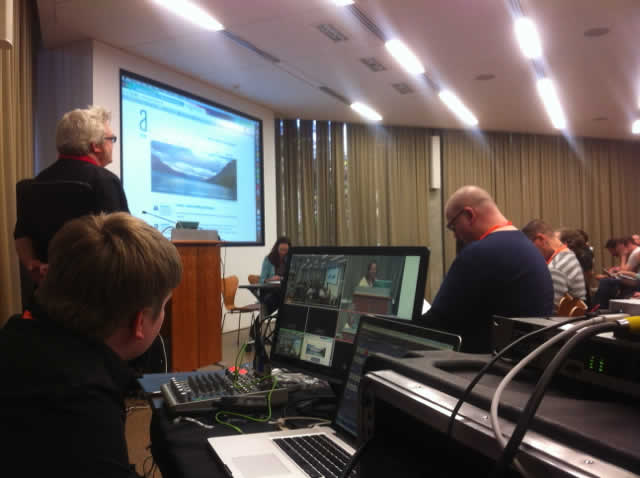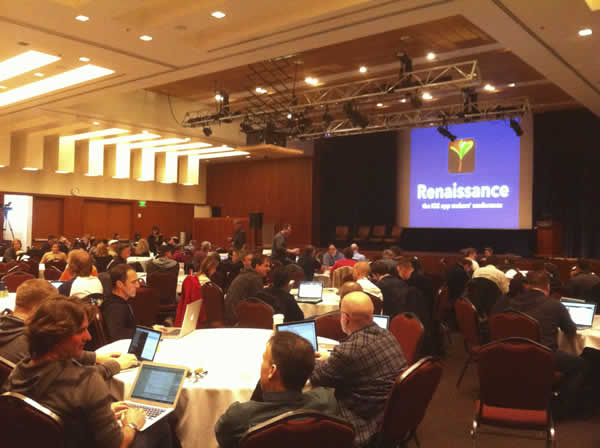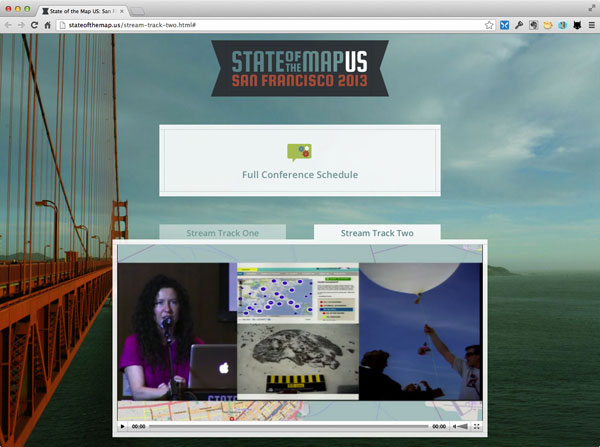

Earlier this month the 2013 State of the Map US conference was held in beautiful San Francisco at the Mission Bay Conference Center June 8-9, and e3 Webcasting was honored to live stream webcast video of each session around the globe. 380+ people came out to talk OpenStreetMap, learn from each other, and move the project forward. Bonnie and Alex from the MapBox team were amazing to work with and made sure we had everything we needed to make the live stream video webcast happen.
Thanks @firefishy1 for the #openstreetmap infrastructure details at #sotmus (seen that from Paris, France thank to streaming)
— Christian Quest (@cq94) June 8, 2013
craigslist and OpenStreetMap
Dennis Watson’s presentation on building a craigslist scale map installation with OpenStreetMap (OSM) data was very insightful. He explained that craigslist serves 50 billion monthly page views to 60 million users across 700 sites in 70 countries, naturalized into 13 languages. Craigslist users post 100 million+ classified ads per month, including more than 2 million new job listings per month, and how self hosting a complete map service from top to bottom at this scale presents many challenges including: live updating of OSM data, map styling and design for sense of purpose, rendering and serving maps to end users, geocoding user input, searching geodetic data, displaying geodetic results in meaningful ways that the end user can understand, giving back to OSM with user data feedback. In his talk Dennis addressed the above issues and discussed how his team implemented the above at craigslist scale. His overview of the zoom tile numbers were staggering at 17 billion tiles. It was great to get an look inside craigslist from a mapping perspective.
Alan McConchie is currently talking about his London editing analysis. Watch the live stream from #sotmus http://t.co/6sELPtKxfy
— OpenStreetMap London (@OSMLondon) June 9, 2013
OpenStreetMap and foursquare
Nathaniel V. Kelso and David Blackman’s presentation on “Introducing Quattroshapes! The Global Polygon Gazetteer”, was a really interesting insiders look into foursquare’s need for quality place data to power its geocoding engine to ensure the best user recommendations. When someone searches for best coffee in Manhattan, a simple venue to place point or venue to place bounding box search can result in venues in Manhattan and Jersey City overwhelming the results for Manhattan. To improve these recommendations, they’ve created an authoritative source of polygons around a curated list of places. This gazetteer of non-overlapping polygons provides more relevant results to users than just simple point geometries. This work is based on several factors including: geocoded photos from Flickr, foursquare checkins, and an extended version of Natural Earth. This new polygon gazetteer data is used in David Blackman’s TwoFishes, the coarse splitting geocoder (and reverse geocoder) written in scala at foursquare. It was great to get to see how foursquare and others are managing their mapping data.
Estamos siguiente la conferencia "El estado del mapa 2013". También vía stream http://t.co/xRLmiLKZjl #SOTMUS #OSMCbba
— OSM Cochabamba (@osmcbba) June 9, 2013
Building Community in Nicaragua
Felix Delattre’s presentation on community mapping in Nicaragua was a great overview on using OpenStreetMap to get people involved and working with technology. And at the same time building community by making a map of the community. Creating an open data map helps grow the local economy and adds value to the city. His talk covered how the OpenStreetMap community gained momentum in the country, what lessons they have learned on community building with OSM, what real life problems exist, what makes mapping in Central America unique, and where the local community wants to go next. His story-telling session about his experiences, the monthly mapping parties, their influence on local politics, and communities, was very engaging.
At starbucks watching #sotmus livestream… :-) a nice surprise
— Glenn Letham (@gletham) June 9, 2013
The State of the Map US was an amazing conference with speakers ranging from the National Park Service to Voxel.js an open source port of Minecraft, to the Redcross and how maps played a huge role in the Haiti earthquake relief efforts and how the OpenStreetMap project was able to give back to the community. If you missed the conference or you missed the live stream webcast of the conference you can watch all the session videos on the State of the Map US conference website. See you next year at the conference or online.
SOTMUS 2013 Conference 411
If you’d like to learn more about the State of the Map US 2013 Conference or would like to attend a conference in the future, you can find out more by visiting the conference website or following them on Twitter:
Website: SOTMUS
Twitter:  @sotmus
Conference Videos On Demand: SOTMUS 2013 Vimeo Channel
Some of our favorite Tweets from the State of the Map US 2013
Ollie Guinan getting ready to speak at #sotmus live stream at stateofthemap.us pic.twitter.com/pZNZzFRwAN
— Skybox Imaging (@skyboximaging) June 9, 2013
Great visualizations of Open Street Map editors in cities by @mappingmashups. Streaming now, Track One http://t.co/YC29jbcWVs #sotmus #osm
— Brian Zelip (@bzelip) June 9, 2013
@osm_fr Y'a quoi ce soir à la TV ? #sotmus en streaming bien sûr ;) #openstreetmap http://t.co/D38JVeRhMC
— Christian Quest (@cq94) June 9, 2013
Thanks to #sotmus organizers for great livestreaming. Great for checking in on what's going on in both sessions.
— Tamara Manik-Perlman (@TamaraMP) June 9, 2013
#opensource mapping is a two-way street. See why folks are turning to #OpenStreetMap at @SOTMUS, streaming live now: http://t.co/mLmsyEdNup
— Zack (@zpez) June 9, 2013
Flere spændende foredrag i dag på #sotmus http://t.co/MYoIqgnXzK livevideo streams kan ses her – http://t.co/Bh7ACwT8lG start om 10 min.
— Søren Johannessen (@neogeografen) June 9, 2013
Catching @mikel's talk on the #sotmus live stream – It may be geekery, but I love hearing this kind of project history.
— Bill Morris (@vtcraghead) June 8, 2013
Don't forget, #sotmus is being streamed live. http://t.co/v9IKQvIxPI
— James Fee (@cageyjames) June 8, 2013
Streaming live at http://t.co/xHYEvuTX8A !!! Next best thing to being at #sotmus
— Steven Johnson (@geomantic) June 8, 2013