
WHAT’S GOING ON

Behind-The-Scenes

In the e3 Webcasting Studio

Renaissance_iOS_Conf.jpg

January 31, 2013 Tim Arthur0

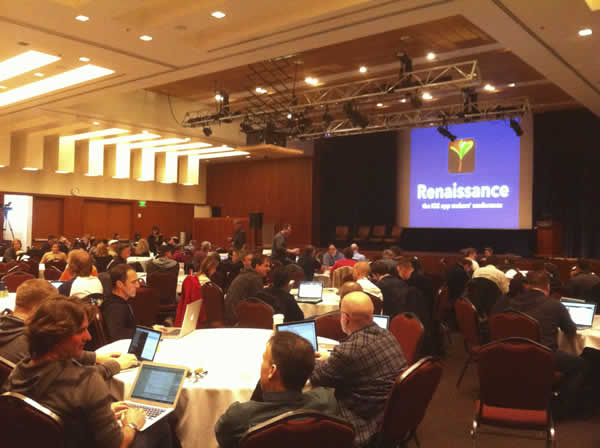
iOS App Makers @ Renaissance iOS Conf

This January, for three days, the best of the iOS app making community came together to instruct those in attendance at the Renaissance.io conference how to excel at the business, design, and technology of making apps. e3 Webcasting was there at the Mission Bay Conference Center to capture the making of the best iOS app makers’ conference. Created by Tim Burks of Radtastical Inc., and Bill Dudney of Gala Factory, Renaissance is the iOS app makers’ conference.

App makers aren’t just programmers. They develop ideas into apps that impact our lives. To kick off day one of the conference Brenda Chapman, who wrote and directed Pixar’s Brave, was on hand to encourage the audience to “Dare It,” by daring to be and to do something different.

There’s no substitute to learning from the best. The Renaissance conference brought together experts in a variety of fields for three days of sharing knowledge and networking. Day two’s Keynote was presented by Ken Segall, ex-Creative Director for Chiat/Day, who worked with Steve Jobs to name the iMac. Ken, encouraged everyone present to “Focus It” and remind us that “Simplicity is not a trend.” Ken’s presentation really made me want to read his book “Insanely Simple.”

After creating a list of the most important subject matter for iOS app makers to know and finding the best people in the industry to speak on those topics, Renaissance’s day three was awe-inspiring. Tim Berry wrapped up the conference with the final keynote charge to go out there and “Do it.” Known as the “the Obi Wan Kenobi of Business Plans“, and Tim Berry closed with advice for critical thinking and planning that we can use to launch our ideas to success.

My top 10 take-aways from the Renaissance Conference:

  • 1. Winning in the App Store – Lux Chen of Esper Labs

    Showcases a great marketing strategy to get you on the charts plus a cross.

  • 2. Winning in the App Store – Lux Chen of Esper Labs

    Also shares a cross-promotion game plan for your game.

  • 3. Winning in the App Store – Lux Chen of Esper Labs

    Presents the per user RIO metrics to you need to know to survive.

  • 4. Winning in the App Store – Jessica Kahn of Disney Interactive Media Group

    Shares one of the research tactics Tapulous used to figure out if that app was going to be a winner or a loser.

  • 5. Apps for Everyone – Brendan Clavin of Tethras

    Presented some very interesting language data for iOS app localization.

  • 6. Apps for Everyone – Brendan Clavin of Tethras

    Shared an interesting localized SEO strategy for naming your next app.

  • 7. Apps for Everyone – Lan Lin of iPhone Localizer

    Explained the keyword difference between apps targeted at the Chinese market vs. apps targeted at the Japanese market.

  • 8. Apps for Everyone – Lan Lin of iPhone Localizer

    Provided a great tip, about how-to test different markets before localizing your complete app.

  • 9. Intentional Marketing – Tan Tmangraksat of Velti

    Showed some really fun revenue charts for iOS apps vs. other platforms.

  • 10. Intentional Marketing – Kat Gordon of Maternal Instinct and creator of the 3% Conference

    Shared the statistic that the average user has 65 apps on their phone and what that means to you as an app developer.

There were too many great take-aways from the Renaissance iOS conference to list them all here. So much so, that you should watch the videos… Click here to view the videos: Renaissance.io.

Renaissance the iOS app makers’ conference 411

If you’d like to learn more about the Renaissance Conference or would like to attend next year’s conference you can find out more by visiting the conference website or following them on Twitter:
Website: Renaissance
Twitter: @renaissanceio
Hashtag: #renio
Facebook: Renaissance


hobbit.jpg

December 31, 2012 Isaac Arthur0

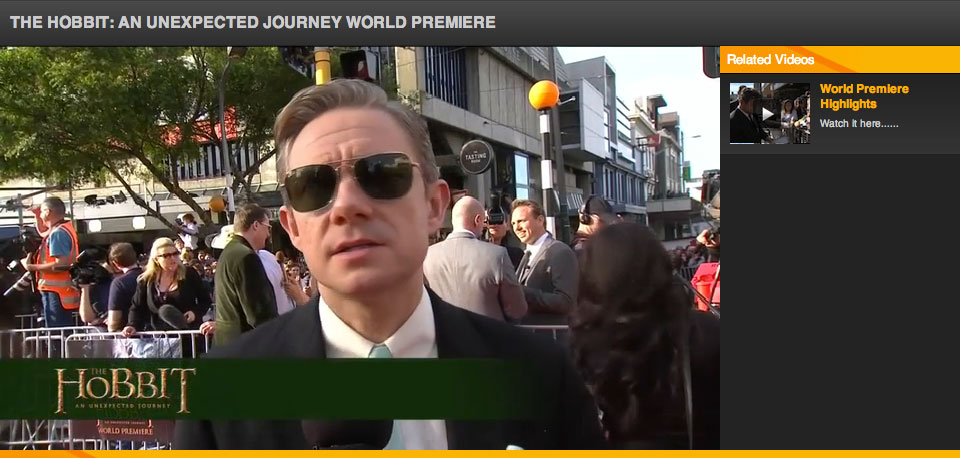
Live stream webcast of the Hobbit Movie World Permiere

Examples of the game-changing nature of webcasting are everywhere you look. From large conferences to political conventions to smaller niche events, live streaming is exploding all over the planet and in many different settings. Now, even major motion picture studios are realizing the value that this powerful resource can bring. This last November, by employing Hollywood event streaming company Now Live, the Warner Bros. and New Line Cinema social media users from around the world were able to virtually travel to New Zealand to participate in one of the most highly anticipated movie events of the year: the world premiere of director Peter Jackson’s newest trek into Middle Earth, the world of author J.R.R. Tolkien’s fantasy literature, The Hobbit: An Unexpected Journey.

I tuned-in to the stream that night, along with thousands of Tolkien and movie enthusiasts: because, being in the business of webcasting, and a fan of the films as well, I had a staked interested. After clicking the link to the stream’s page on Facebook, it was apparent that they had rolled out the red carpet, not only for the film’s cast and crew, physically in attendance in Wellington, but also for the curious and expectant audience across the globe. Those watching the live stream of the pre-show premiere festivities were treated to sweeping shots of the lengthy red carpet, musical performances by Neil Finn and his band (Finn is a New Zealander himself and the music artist behind the “Song of the Lonely Mountain” which is featured in the movie’s credits) and up-close interviews with the actors and filmmakers who created the film. Even if one had the opportunity to be there in person, one probably wouldn’t have had a better experience than sitting at home watching the stream.

Between delighting fans with behind-the-scenes stories and glimpses of their favorite actors, as well as enticing others to find out more about the film, and boosting the hype and excitement about The Hobbit before its theatrical release, the live stream webcast was a huge success. All the music, the celebrity sightings, and the sneak peeks at movie itself (not shown in the live stream, of course) had the effect of generating even more word of mouth and anticipation. Hollywood marketers know how to pack people in and the live-streamed premiere is just one way that technology has given studios a way to reach audiences. The movie has been in theaters since December 14 and has remained in the Top 10 in the box office, currently #1 – ahead of the Django Unchained and Les Misérables – and has grossed $222.7 million. Not to commit the fallacy of assuming that the live stream webcast was the deciding factor here, yet one does have to wonder how live streaming technology could have helped reach greater numbers of filmgoers and propelled the other films to the top slot now occupied by Peter Jackson’s The Hobbit. Speculation aside, it is quite clear that live streaming is quickly becoming an indispensable tool for conferences, events, and the silver screen.


Redis-Conf-Grfx.jpg

October 27, 2012 Isaac Arthur0

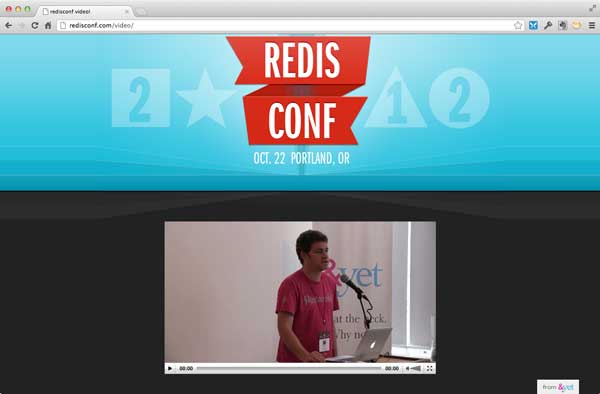
Aren Sandersen from Pinterest, @P-arensand, presenting at RedisConf

On October 22, e3 Webcasting live streamed the RedisConf in Portland, Oregon. It is a one day conference born out of the larger Realtime Conference put on by web application and design company &yet, focused specifically on the niche of programmers and developers who use the open-source database known as Redis, which is a development project sponsored by VMware.

The amazing team at &yet, led by Adam Brault, created a welcoming, unique, and creative environment for their diverse community to come together. Though a smaller-scale gathering, compared to it’s big brother the Realtime Conf, the RedisConf was well organized and stimulating. People from all over the United States, as well as internationally, came to this once-a-year event. It was a chance to network, discuss ideas, get updates on the progress made by other colleagues from around the world, and learn new techniques. Where the Realtime Conf would deal with the wider spectrum of topics related to realtime application development (for laymen, think Twitter instantly updating posts in “realtime”), the Redis Conference dug into the pros and cons related to using Redis as a multi-use tool on the Internet.

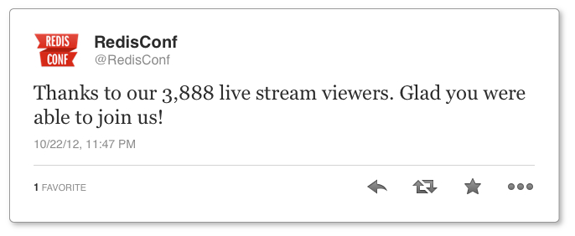
Tweet by @RedisConf

The &yet team kicked off the RedisConf with a performance of Bohemian Rhapsody rewritten from a RedisConf point of view. Streaming live from The Cleaners at the Ace Hotel, over the Internet connection &yet had installed by the pro’s at Stephouse Networks, the conference was off to a great start. Speaker after speaker got up and presented to the audience of about 150-200 men and women in the room; Pieter Noordhuis, @pnoordhuis was on hand to talk about the Redis Core, and Salvatore Sanfilippo, @antirez, even spoke from his home in Italy via several pre-recorded videos.

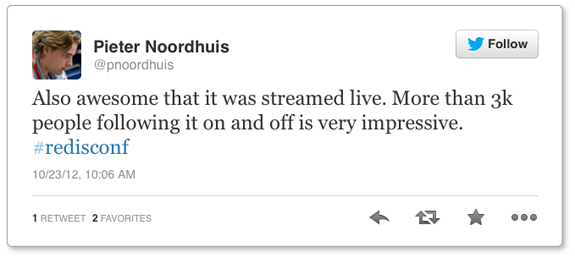
Tweet by Pieter Noordhuis @pnoordhuis

The conference attendees listened with laptops open, absorbing the info; while we were busy making sure that the people who were watching online had the best possible video experience. As the day went on, an Amazon AWS EC2 outage started unfolding. Which, as reported by Techcrunch, affected major services such as Foursquare, Reddit, Minecraft, GitHub, Heroku, imgur, Pocket, Coursera and HipChat. Providentially, we were unaffected and the video stream went off without a problem! Overall, though there are always things that could have been improved, the RedisConf stream was a huge success. Later, we were informed by Adam Baldwin of &yet that the live stream had been watched by as many as 3,000 online viewers!

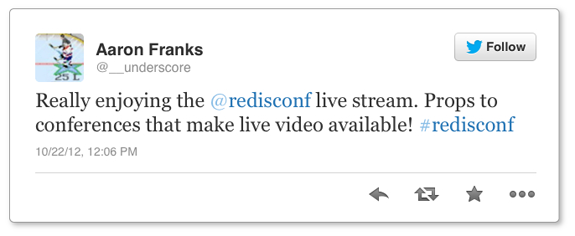
Tweet by @__underscore

People raved about the live stream on Twitter. They were impressed by the quality of the video, and they voiced their enthusiasm online. The RedisConf live web stream was a smash hit!

Many conferences think live-streaming is too expensive to be a viable option for smaller events, or have had negative experiences with poorly executed webcasts in the past. Many remote viewers were grateful for the chance to view the conference even though they were unable to attend in person. I suspect that there are many other conferences out there that could benefit from a well-done live stream webcast.

[message type=”custom”]

RedisConf 411

If you’d like to learn more about the RedisConf or would like to attend next year’s conference you can find out more by visiting the conference website or following them on Twitter:
Website: RedisConf
Twitter: @redisconf
Hashtag: #redisconf
[/message]


Mobile-Map.jpg

July 10, 2012 Isaac Arthur0

[custom_frame_left]
10 Reasons Why Your Event Webcast Needs a Mobile Friendly Site[/custom_frame_left][clear]

Thank you AD:60. The team at AD:60 recently released an infographic depicting “10 Reasons Why You Need a Mobile Site.” Because this is something of utmost importance to the process of webcasting an event, it would be profitable to reiterate the points made by AD:60. After seeing these reasons you’ll see why a mobile site is an increasingly indispensable aspect of webcasting.

[custom_frame_left]
10 Reasons Why You Need a Mobile Site Infographic[/custom_frame_left]
10 Reasons Why You Need a Mobile Site Infographic by AD:60

Following are some e3 Webcasting observations on the above infographic:

  • 1. 8% of all digital traffic comes from smartphones and tablets.

    8% may not seem that significant, until one puts it into the context of the following reasons.

  • 2. Most mobile phones in America will be smartphones by the end of 2012.

    This point is accompanied by a graph that shows how, in 2010, according to the graphic, Nielsen Mobile Insights 70% of mobile phones were feature phones and only 30% were smartphones, which have steadily climbed over the past two years to where they are nearly 50-50 at this point. Based on that, it is expected that smartphone usage will soon surpass feature phones, which probably will in turn affect the percentage given in Reason 1.

  • 3. More and more users are making purchases on their phones.

    As smartphones multiply, more and more people are using their phones to make purchases. As this graph shows, in 2010 purchases made on phones was only at 23%. By 2012 that number has grown to 35% and it is predicted to be as high as 43% by the year 2015.

  • 4. The proportion of mobile-only users is even higher in developing countries.

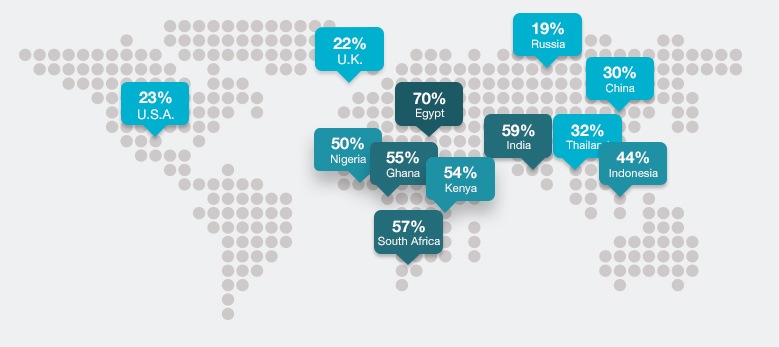
    A map on this graphic depicts the fact that while nations more developed have a relatively low percentage of mobile-only users (23% for the U.S.A., 22% in the U.K. and only 19% in Russia), nations such as Egypt (70%), India (59%), South Africa (57%), Nigeria (50%) and Indonesia (44%) have notably higher numbers. A good mobile site is necessary, but even more so if your market/audience is global. There is no excuse for a worldwide event or corporation to not have a good mobile site.

  • 5. Mobile commerce is growing fast.

    Forrester Research Mobile Commerce Forecast reported that while mobile commerce was only $3 billion in 2010, it has reached $10 billion now, in 2012, and is forecasted to increase to more than ten times where it was in 2010 by 2016, at $31 billion!

  • 6. Smartphone users cover a wide demographic.

    The infographic tells us that smartphones are used by 67% of those between the ages of 18 and 24. Going on, 71% of those 25-34 years, 54% of 35-44 year-olds, 44% between 45 and 54 years, 31% of people 55-84 years and 13% of those 65 years and up use smartphones. This is a large and wide demographic. Of those, 14% of men and 9% of women have made purchases on their phones. You cannot afford to ignore this demographic.

  • 7. Couch commerce is rising.

    59% of customers are using their mobile devices to shop from their homes. Just as online stores became necessary with the coming of the Internet, so too as mobile use picks up it becomes more and more essential to businesses/corporations/events to have mobile friendly sites.

  • 8. Smartphone users have higher than average income.

    The median U.S. household income is roughly $50,000 – while 60% of smartphone users earn more than $100,000. With more than double the average U.S. income, reaching these potential customers with a mobile friendly site becomes an indispensable must.

  • 9. Mobile sites are important for both physical and digital stores.

    This is so, says AD:60, because 46% of customers will use their phone to research products before making an in-store purchase. 41% will research and then buy on a computer, and 37% will make their purchase via phone after researching on a mobile device. This information lets us infer that having a good mobile site is vital for physical stores, even more than for online ones.

  • 10. Your normal site is NOT thumb-friendly.

    With the majority of smartphones being touch-screen, not having a mobile site is very damaging for digital traffic. The regular site is created for a computer screen, thus requiring a lot of thumbing, pinching, zooming – unwanted hassle – for mobile users to navigate a site; this weakens their response to what your site has to offer. Who wants to exert that much energy? Getting a sharp mobile-friendly site will help you to better receive the benefits cited in Reasons 1-9.

  • That wraps-up the “Ten Reasons” on the infographic, and already there are copious reasons to get a mobile-friendly site. I would add just one more reason, in relation to our purposes:

  • 11. Mobile sites are important for webcasting.

    Without a mobile-friendly site your webcasting venture (be it a conference, event, or whatever), will exclude a large percentage of your audience. Viewing a live-streamed video on a mobile device when the site was created for the desktop PC is difficult and frustrating; but with a mobile-friendly site ready for subscribers who are viewing on their smartphones, you provide a much more professional and appealing presentation for the event’s audience. A mobile site, as AD:60 has illustrated so masterfully, is indispensable for websites in general, but with a live streamed event, where you have no idea if your potential audience will be on a computer or a device, than their importance must be stressed even more emphatically.

We’ve now seen the ten (or eleven) reasons why your webcast needs a mobile-friendly site. There is no reason to hesitate in taking advantage of the benefits that they bring. As time goes on, it appears that this will become even more needed. So why not? Mobile users the world over are waiting.


e3 Webcasting
Privacy Overview

This website uses cookies so that we can provide you with the best user experience possible. Cookie information is stored in your browser and performs functions such as recognising you when you return to our website and helping our team to understand which sections of the website you find most interesting and useful.